
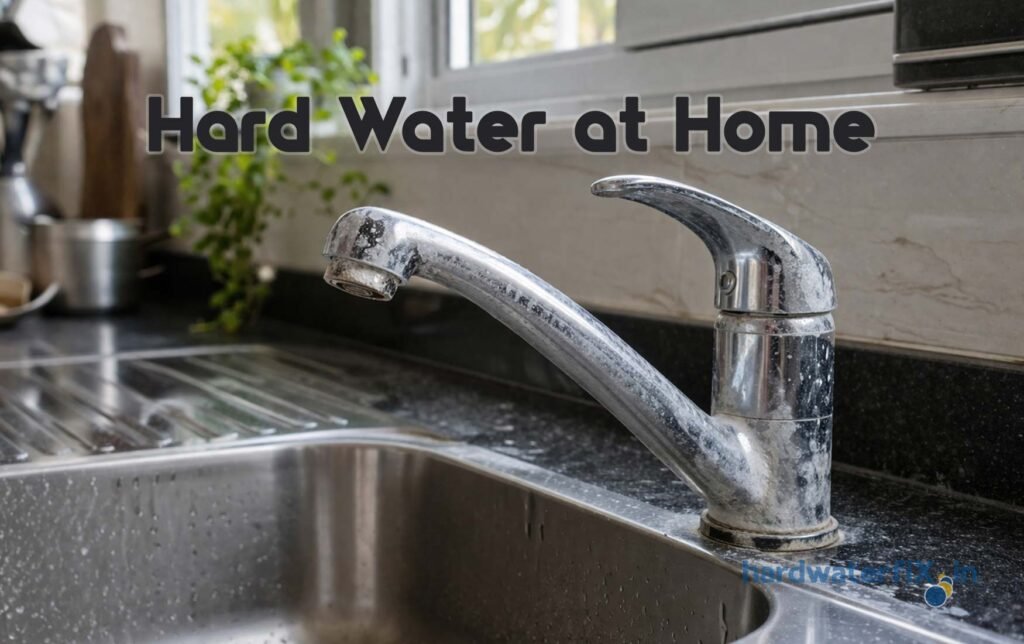
Signs You Have Hard Water at Home
You usually do not need a lab report to suspect hard water. Your tap, shower, tiles, kettle, geyser, glassware, skin, and laundry often start giving you clues long before you see a number on a report. In simple terms, hard water means water with enough dissolved minerals, mainly calcium and magnesium, to react with soap, leave deposits, and create scale. Under IS 10500, India’s drinking water standard, total hardness has an acceptable limit of 200 mg/L as CaCO3, with a permissible limit of 600 mg/L when no alternate source is available. WHO and USGS describe hardness in the same practical way: more soap use, more deposits, more scale. [1] [2] [3]
Quick answer
If you keep seeing white stains on taps, crust around shower nozzles, soap that refuses to lather well, dry or tight feeling skin after bathing, rough feeling hair, stiff laundry, cloudy glassware, or a geyser that seems to lose efficiency faster than expected, hard water becomes a serious possibility. Still, symptoms only point you in a direction. They do not confirm the cause on their own. A water test or a readable water report is what confirms whether hardness is actually high enough to matter in your home. [4] [5] [6]
Why these signs show up in real life
Hard water behaves differently from soft water when you wash, rinse, and heat it. WHO explains that hard water reacts with soap, needs more soap to produce lather, turns water milky, and often leaves a visible precipitate or ring in containers and on surfaces. That same document also explains that hard water can increase soap consumption and scale deposition in heated applications, coating surfaces and reducing heat transfer efficiency. That is why your bathroom may look dull, your fittings may keep collecting chalky marks, and your geyser or other hot water equipment may need attention earlier than you expected. [2]
The signs you may notice at home
White stains on taps, fittings, tiles, and glass
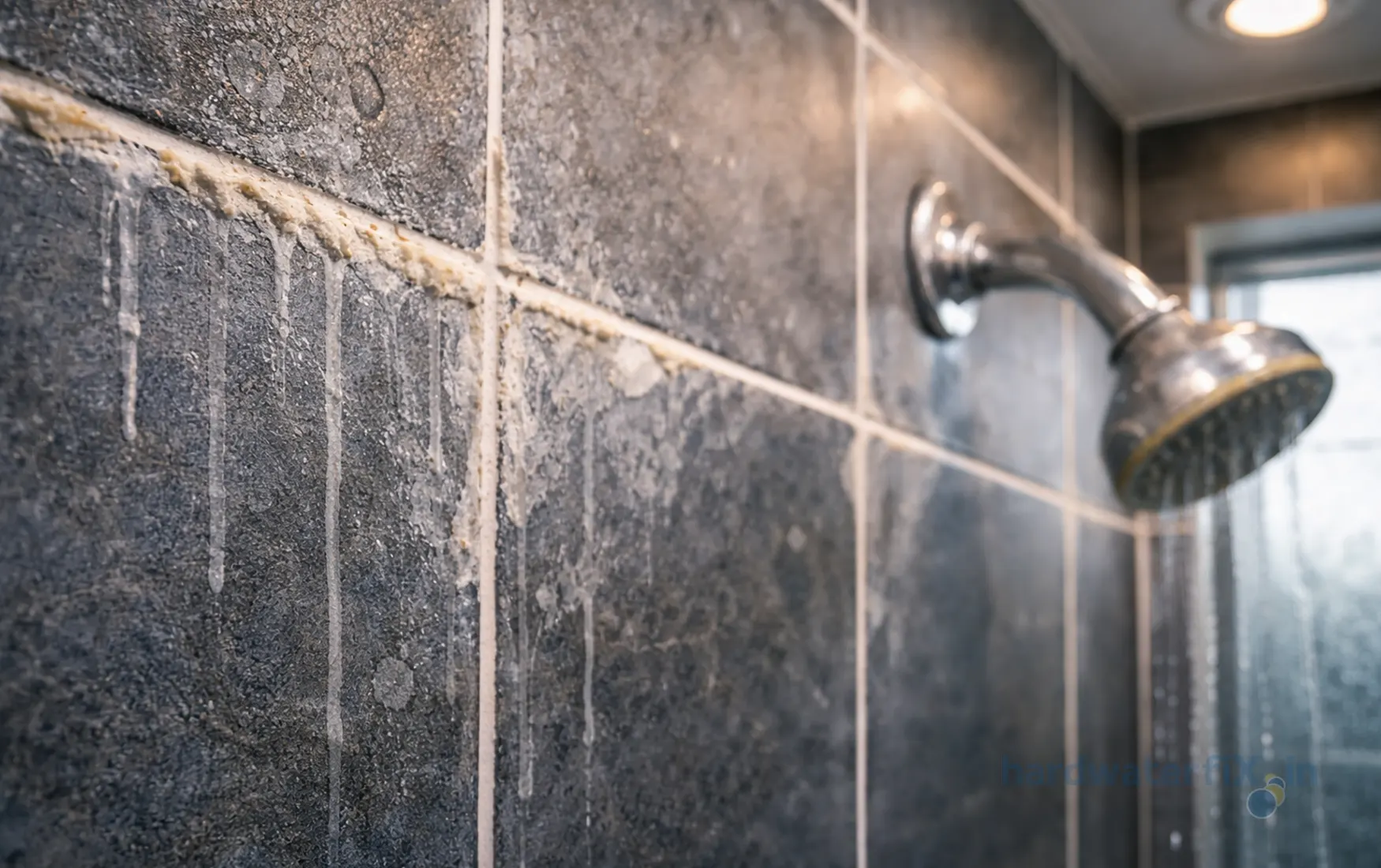
This is one of the clearest clues. When mineral rich water dries, it can leave a pale residue or crust. WHO describes this as a noticeable deposit of precipitate, and Bosch’s dishwasher manual describes hard water as leaving limescale on dishware and inside the appliance. If you keep wiping the same white marks and they return fast, hardness moves higher on the suspect list. [5] [2]
Soap that does not lather well
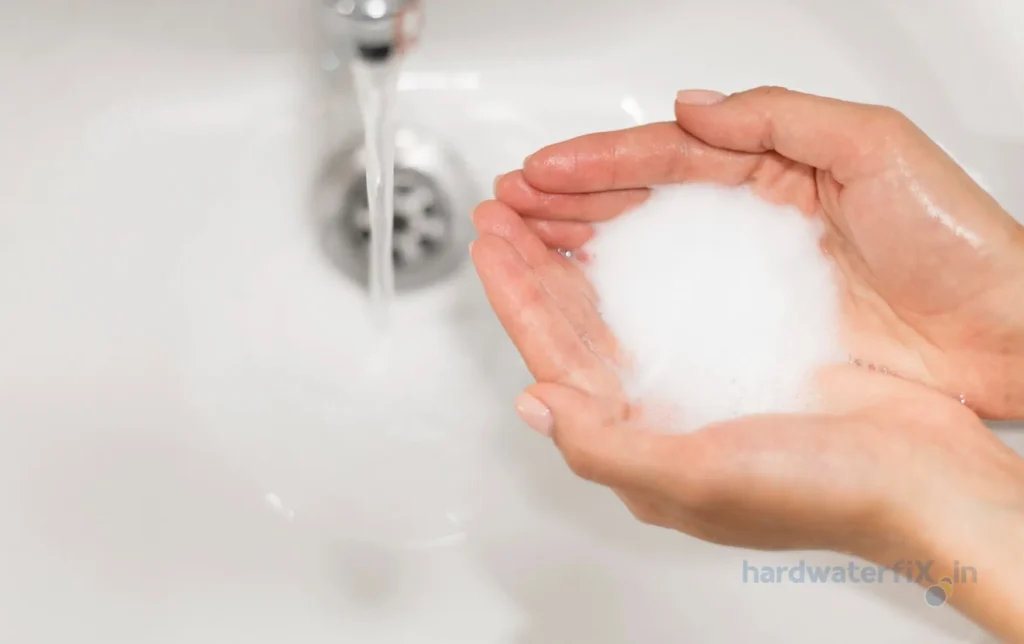
If you need more soap, shampoo, or body wash just to get a normal feel, that matches the classic definition of hardness. WHO describes hardness as the capacity of water to react with soap, with hard water needing much more soap to produce lather. This sign matters because you can feel it every day, even before you see scale on metal or tiles. [2]
Dry or tight feeling skin after bathing
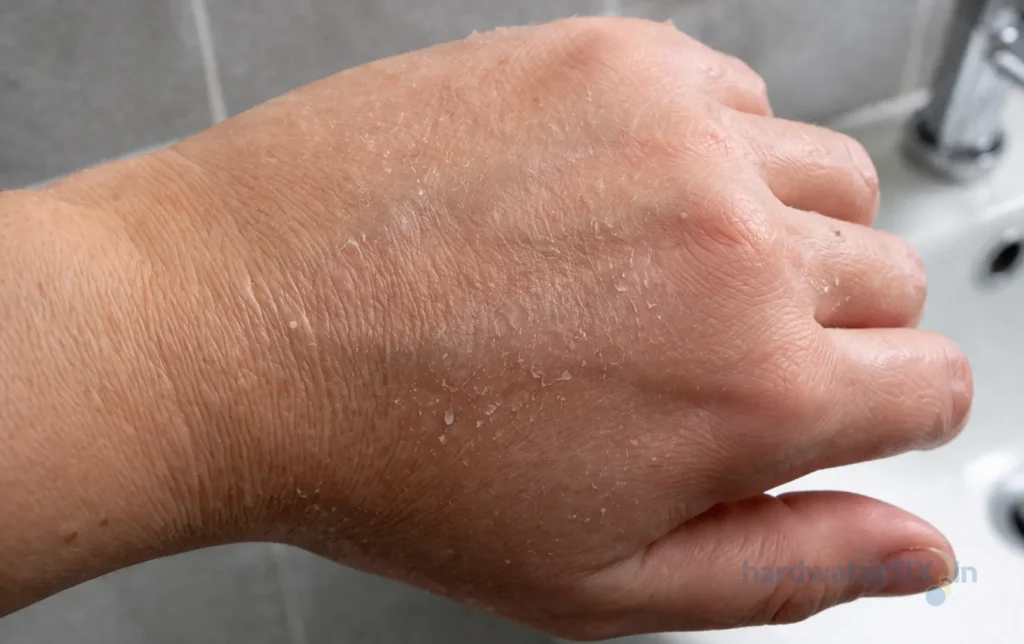
You may feel as if soap never fully rinses off, or as if your skin feels stretched after a shower. WHO notes that hard water can leave metal or soap salt residues on skin or clothes that are not easy to rinse away and may lead to contact irritation. Some research has found an association between harder domestic water and eczema risk, especially in early life, but softened water has not consistently improved established eczema. So this sign can point toward hard water, but you still need to check other factors such as soap choice, hot water temperature, bathing frequency, and any existing skin condition. [7] [8]
Rough feeling hair after a shower

If your hair starts feeling coated, less smooth, or harder to manage after washing, hard water may be part of the picture. One published study found higher calcium and magnesium deposition on hair treated in hard water than on hair treated in distilled water. That does not mean hard water is the only cause of rough hair, and it does not prove hair fall. It simply means mineral deposition on hair is real enough to take seriously when the shower is one part of a bigger pattern at home. [9]
Scale on shower heads and faucet nozzles
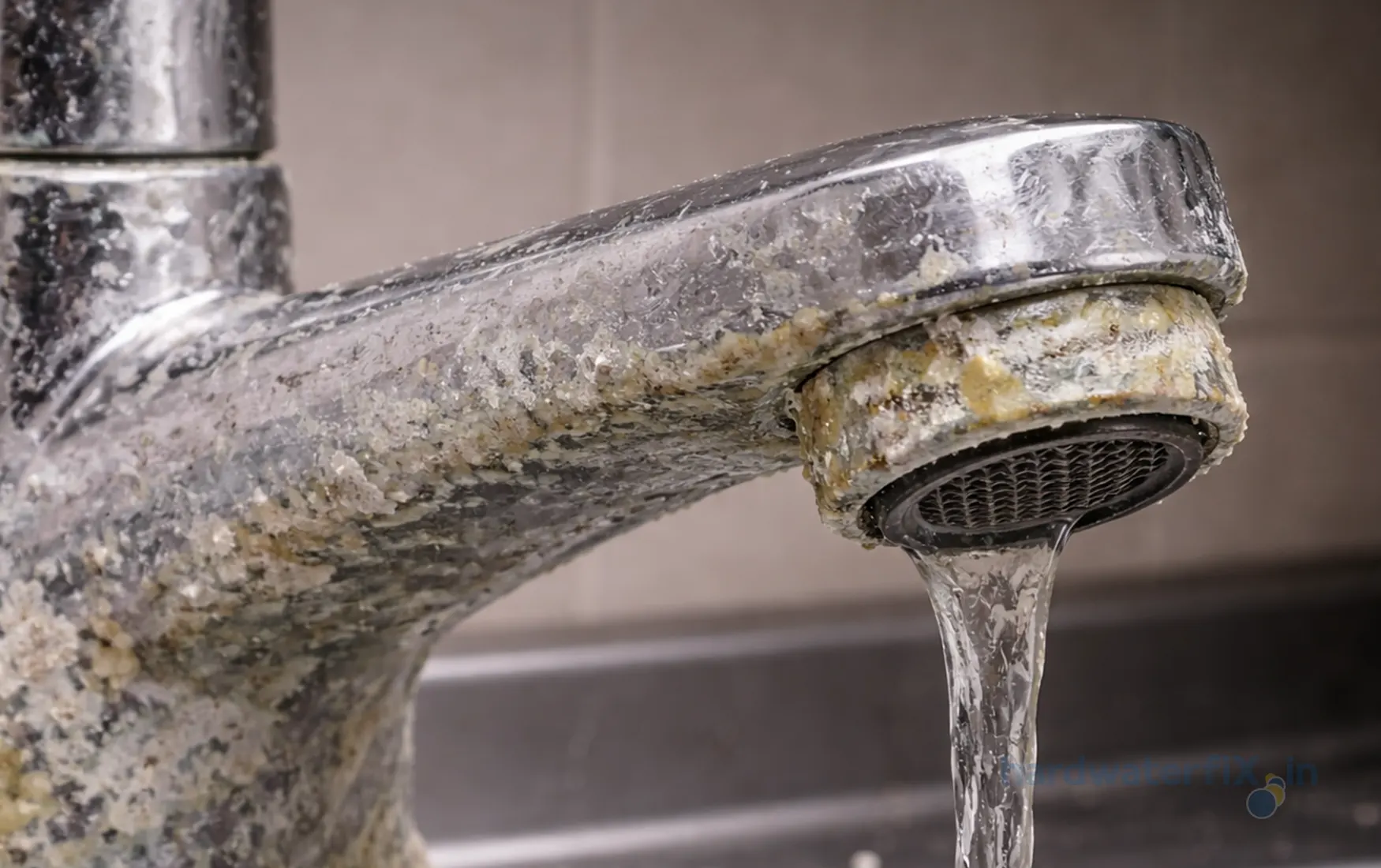
If nozzle holes keep choking, water spray turns uneven, or flow starts dropping, scale may be building up where water evaporates or gets heated. That fits what WHO describes about scale deposition in water systems and heated applications. In ordinary home use, this often shows up first in shower heads, tap aerators, kettle elements, and inside geysers. [2]
Stiff clothes and dull laundry
WHO notes that softening can improve laundry and washing characteristics. That matters because minerals can interfere with how soap works and can leave residues behind. If washed clothes feel rough, lose softness, or look less fresh even after a proper wash, hardness is worth checking, especially when the same home also shows scale on fittings. [2]
Geyser or hot water appliance losing efficiency
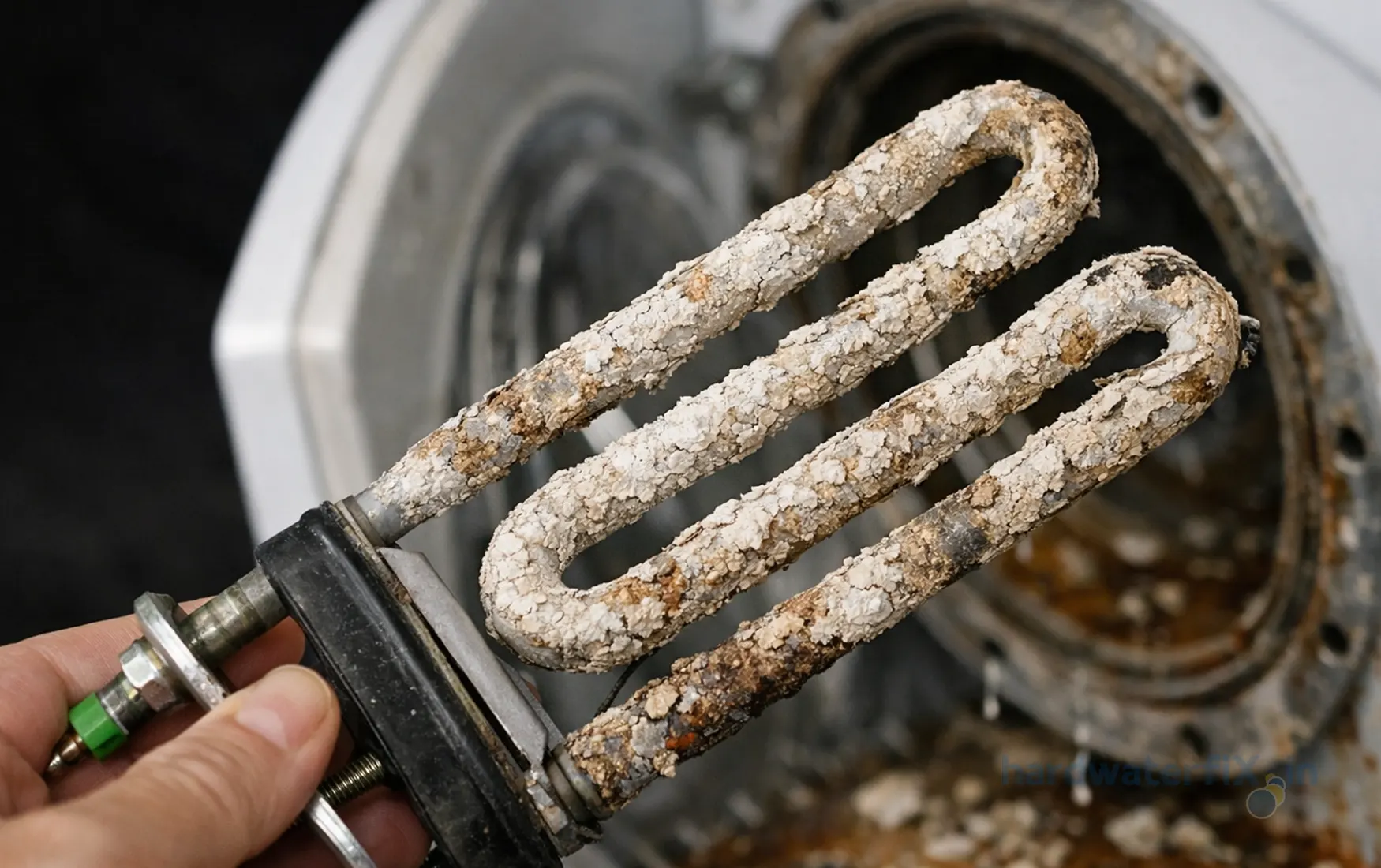
This is a bigger sign because it starts costing you money. WHO states that scale in heated applications can coat surfaces and reduce heat exchanger efficiency. A. O. Smith’s India water heater manual lists scale deposition as a cause when water heats slowly, says the inner tank and heating element need periodic cleaning of deposits or scales for efficient operation, and says scale cleaning is not covered as a routine warranty service. That is exactly why hard water is not just a cosmetic annoyance. It can become a maintenance problem. [6] [2]
What not to confuse with hard water
Hard water is not the same as dirty water. Hardness is mainly a dissolved mineral issue, not a visible dirt issue. Water can look clear and still be hard. Water can also look stained or smell odd for reasons that have nothing to do with hardness, such as iron, manganese, sulphide, or other water quality problems. [10] [2]
High TDS is not the same as high hardness. On a proper report, TDS and hardness appear as separate items. BIS lists both total dissolved solids and total hardness separately. EPA also lists TDS as a nuisance or aesthetic issue that can be linked with deposits and staining, but that does not turn TDS into a direct substitute for hardness. You can have higher TDS with only moderate hardness, and you can also have hard water that needs attention even when you are focusing too much on the TDS number alone. [1] [10]
RO and softener do not solve the same problem. WHO notes that point of entry ion exchange softeners remove hardness minerals such as calcium and magnesium, while point of use reverse osmosis removes a much wider range of dissolved material and can also remove minerals from water. If your main complaint is scale on fixtures, geyser issues, soap performance, and bathroom deposits, you need to check hardness before assuming an RO is the right fix. [2]
| What you notice | What hard water can mean | What else could also be going on | What you should check next |
|---|---|---|---|
| White marks on taps and tiles | Mineral residue or limescale | Evaporation marks from other dissolved solids | Check total hardness and TDS on a report |
| Soap does not lather well | Water reacting with soap | Low quality soap or wrong product for the job | Check hardness first |
| Dry skin or rough feeling after bath | Soap or mineral residue may be contributing | Hot water, skin condition, bathing products | Check hardness, bathing routine, and product use |
| Rough feeling hair | Mineral deposition may be building up | Hair products, bleach, heat styling, scalp issues | Check shower water hardness and overall home pattern |
| Slow geyser heating or repeated scaling | Scale in heated water equipment | Appliance age or service issue | Check hardness and inspect for scale |
| Stiff laundry and cloudy glassware | Washing performance affected by minerals | Detergent dosing or rinse issue | Check hardness and washing setup |
How to read this on a water report
If you have a lab report, look for total hardness, usually written as mg/L as CaCO3. That last part, CaCO3, simply means calcium carbonate equivalent, which is the standard way labs express hardness. Under IS 10500, 200 mg/L is the acceptable limit and 600 mg/L is the permissible limit in the absence of an alternate source. USGS uses a practical classification that many people find easy to read: below 60 soft, 61 to 120 moderately hard, 121 to 180 hard, and above 180 very hard. That means a report can already look very hard by common classification before it crosses the upper Indian permissible limit. [1] [3]
If your report only shows TDS and not hardness, you still do not have the full answer. Ask for a proper hardness value. If your report shows hardness, calcium, magnesium, TDS, iron, pH, and source details, you can make a much better decision about whether you need a softener, an RO, a mixed treatment setup, or just better maintenance and cleaning in specific lines. [1] [10]
One mistake that can waste your money
Do not jump from white stains straight to buying a machine. White stains can point toward hardness, but you still need the number. You also need to know whether your main pain sits in your bathroom, your hot water line, your kitchen drinking water, or your full home supply. If you skip that step, you may buy an RO for a hardness problem, or a small point product for a whole home scaling problem.
What you should do next
If two or more of these signs keep showing up together, do this next. Take a few clear photos of stains, scale, and affected fittings. Check whether the same pattern shows up in the bathroom, kitchen, geyser, and laundry. Then get a water test that includes total hardness, or upload your water report for review. That one step moves you from guessing to deciding.
Check your water symptoms and compare them with your water report.
Upload your report so you can stop guessing and start checking the right thing.
You can start here on the site:
- Start Here
- Find Your Fix
- What Is Hard Water
- Hardness vs TDS
- Water Testing
- Submit Your Water Report
- How We Use Water Reports
FAQ
Yes. Hardness is about dissolved minerals, not whether the water looks muddy or dirty. [2]
No. TDS and hardness are related only in part. A report should show them separately. [1] [10]
Not by itself. Hard water can contribute, especially when soap residues or skin sensitivity are part of the picture, but you still need to rule out product choice, water temperature, and skin conditions. [7] [8]
Yes. WHO notes that groundwater often shows significant hardness, but some larger surface water supplies can show the same issue too. What reaches your home can also vary with source mixing and storage conditions. [2]
References
- Bureau of Indian Standards. IS 10500: 2012 Drinking Water Specification. Total dissolved solids and total hardness appear as separate parameters. Total hardness acceptable limit: 200 mg/L as CaCO3. Permissible limit in the absence of alternate source: 600 mg/L.
- World Health Organization. Hardness in Drinking Water. Hardness is described as water reacting with soap, leaving deposits, increasing soap consumption, and causing scale in heated applications. The document also notes residues on skin or clothes, possible contact irritation, and improved washing or laundry characteristics with softening.
- U.S. Geological Survey. Hardness of Water. Common hardness classes: soft below 60 mg/L as calcium carbonate, moderately hard 61 to 120, hard 121 to 180, very hard above 180.
- Bosch. Use and Care Manual SHX9PCM5N. Hard water leaves limescale on dishware and inside the appliance; parts may become blocked.
- Bosch. Use and Care Manual SHX9PCM5N. White coatings on dishware and inside the appliance can reflect incorrect softening settings or water that is too hard.
- A. O. Smith India. HAS X / HAS X LHS Water Heater User Manual and Warranty Card. Troubleshooting lists scale deposition as a cause of slow heating; the manual also says tanks and heating elements need periodic cleaning of deposits or scales for efficient operation, and routine scale cleaning is outside warranty coverage.
- Jabbar Lopez ZK, et al. The effect of water hardness on atopic eczema, skin barrier function: a systematic review and meta analysis. PubMed abstract summary notes a reported association between hard domestic water and atopic eczema, especially in early life.
- Perkin MR, et al. Water hardness and a possible genetic link with eczema in children. Summary notes that harder water has been linked with more childhood eczema in some work, while a study using water softeners in children with eczema did not show a difference in severity.
- Srinivasan G, et al. Scanning electron microscopy of hair treated in hard water. PubMed abstract summary reports higher calcium and magnesium deposition on hair exposed to hard water.
- U.S. Environmental Protection Agency. Secondary Drinking Water Standards: Guidance for Nuisance Chemicals. TDS is listed as a separate aesthetic or nuisance parameter associated with deposits, staining, and taste issues.