
Water Hardness Versus TDS
If you are looking at a water report, a TDS meter reading, or white scale around your home and wondering whether all of it means the same thing, you are not alone. This confusion is very common. The clean answer is simple. Water Hardness and TDS are related, but they do not mean the same thing.[1][2][3]
That difference matters because one wrong assumption can push you toward the wrong fix. You may see a high TDS reading and assume that proves hard water. You may see scale on taps and assume the TDS number must explain everything. Both shortcuts can mislead you. The safer path is to read each number for what it actually tells you.[1][2][3]
The Short Answer
If you want the shortest useful answer, here it is.
Water Hardness mainly tells you about calcium and magnesium in your water.
TDS tells you about the total dissolved load in the water from a much wider mix of substances.
So if you only know your TDS, you still do not know your hardness.[2][3]
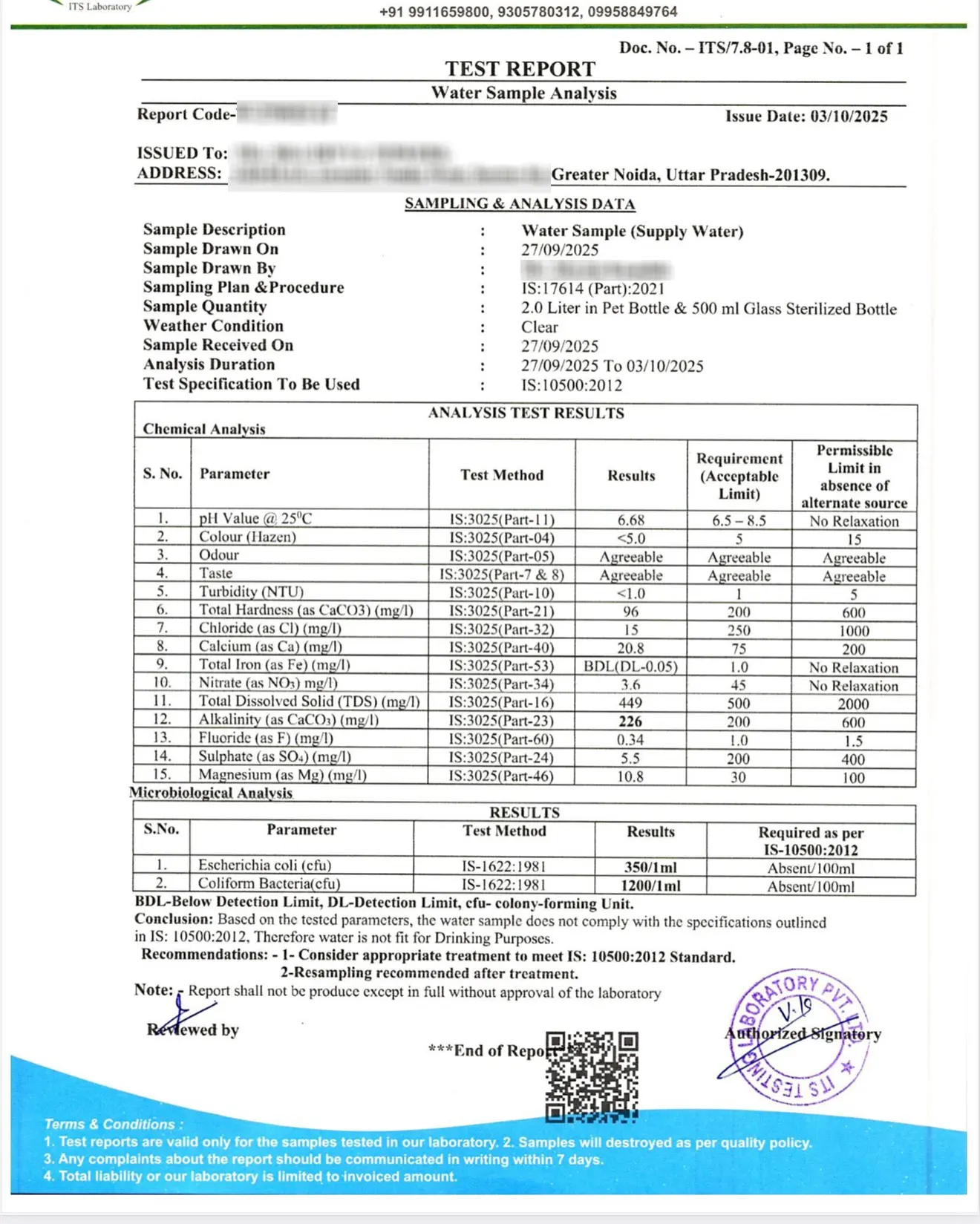
Sample Water Test Report
What Water Hardness Is Really Telling You
When you see total hardness on a report, that number is mainly about calcium and magnesium. It is commonly written as mg/L as CaCO3. In normal home life, hardness often shows up as scale, soap scum, poor lather, and white mineral marks on fittings and tiles. WHO also describes hardness as the traditional measure of water’s capacity to react with soap, which is why harder water needs more soap to make a lather.[1][2]
So if you keep seeing white crust on taps, scale on shower heads, or mineral buildup inside a geyser, hardness deserves real attention. That does not mean hardness explains every water issue in your home. It means hardness is one of the first things worth checking when scale is your main complaint.[2]
What TDS Is Really Telling You
TDS means total dissolved solids. This number covers a much broader group of dissolved material in the water. WHO describes it as including salts such as calcium, magnesium, sodium, potassium, bicarbonates, chlorides, and sulfates, along with small amounts of organic matter. So TDS is a wider bucket. Hardness may sit inside that bucket, but it is not the whole bucket.[3]
That is why a TDS reading can tell you that dissolved material is present, but it cannot tell you by itself whether hardness is the main reason for the problem you are facing at home.[3]
Why This Difference Matters In Real Life
If your main problem is scale, poor soap lather, white marks on fittings, or mineral buildup in a geyser, hardness is usually the more useful number to check closely. If your only number is from a handheld TDS meter, that reading may still help as a clue, but it is not enough on its own to explain the full problem.[2][3]
This is where you can get stuck. You may see one ppm reading and feel like you already know what is wrong. In reality, one TDS number cannot replace a proper report that separates hardness from TDS.[1][3]
How To Keep The Two Separate In Your Mind
A simple way to think about it is this.
- Hardness is the number that often connects more directly to scale and soap behavior.
- TDS is the number that gives you a broader view of dissolved material in the water.
- Hardness is often shown as total hardness in mg/L as CaCO3.
- TDS is often shown as mg/L or ppm.
- One number does not replace the other.
What The Indian Standard Says
Under IS 10500:2012, the acceptable limit for TDS is 500 mg/L, and the permissible limit in the absence of an alternate source is 2000 mg/L. The same standard sets the acceptable limit for total hardness as CaCO3 at 200 mg/L, with a permissible limit of 600 mg/L in the absence of an alternate source.[1]
That point matters because the Indian standard lists hardness and TDS separately. So when you read your report, you should read them separately too.[1]
The Mistake You Want To Avoid
A very common mistake looks like this.
- You see a high TDS reading.
- You assume that proves hard water.
- You choose a fix based on that one number.
That path can lead you in the wrong direction.[1][2][3]
A better path is simpler. Start with the actual clue you are seeing at home. Then check whether your report shows hardness and TDS separately. Once you have both numbers, you can make a much better decision about what kind of help your water actually needs.[1][2][3]
GUIDED WATER PROBLEM CHECKER
Find the right fix for your water problem. Helps you turn that into a better next step, after this guided assessment.
Find Your Fix
What You Should Check Next
If you only have a handheld TDS reading, treat it as a clue, not a full diagnosis.
If you already have a lab report, check whether it lists these lines separately.
- Total hardness
- TDS
- Calcium
- Magnesium
- Alkalinity
If you do not have a proper report yet, start there. A public route in India is the Jal Jeevan Mission WQMIS laboratory locator, which helps you find water testing laboratories.[4]
If you want a clearer answer for your own home, the most useful next step for this post is simple. Submit your water report. One proper report usually tells you much more than a guess based on scale or one ppm reading.
Read Next
References
- IS 10500:2012 Drinking Water Specification. Bureau of Indian Standards. Second revision. Read source ↩
- Hardness. World Health Organization. Chemical fact sheet in the Guidelines for Drinking Water Quality. Read source ↩
- Total dissolved solids. World Health Organization. Chemical fact sheet and background document in the Guidelines for Drinking Water Quality. Read source ↩
- WQMIS Laboratories Information. Jal Jeevan Mission, Government of India. Water quality laboratory locator. Read source ↩